

The accuracy of a servo gearbox is most commonly specified as backlash. Since a gearbox is a rotational device, this value is given in angular units. The typical unit of measure for precision gearboxes is arc-minutes. One arc-minute is 1/60th of a degree.
The backlash of a gearbox is measured by locking the input—driven or motor side—loading the output in one direction, then loading it in the opposite direction, and measuring the displacement. The load used to perform the test is not arbitrary. The typical value is 1–2% of nominal torque capability. In this range, torsional windup from loading the components in the gearbox is minimized, so that primarily backlash is measured. This gives the value of lost motion when there is a reversal of torque during operation.
Contributing Factors to Backlash
When considering backlash in a gearbox, we need to examine the accuracy of the individual gears that comprise the gearbox. The physical characteristics that influence backlash are runout, pitch deviation, pressure angle deviation, and helix angle deviation.
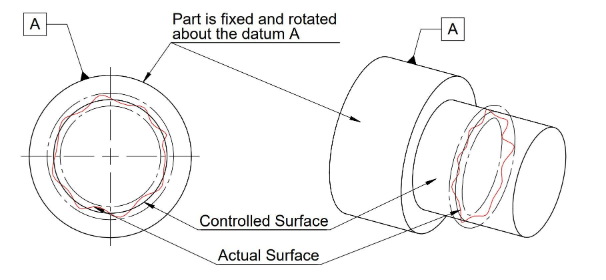
Runout
The first consideration is the roundness of the gear itself. This is referred to as runout, which is the change in the radius of the gear over a full revolution. In areas where the gear is less than the designed diameter, backlash is larger.
Pitch Deviation
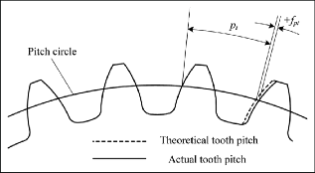
Also known as tooth-to-tooth error, pitch deviation is the difference in position from one tooth to the next. More space between successive teeth increases backlash, while less space decreases backlash.
Pressure Angle
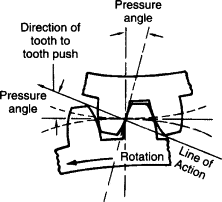
As gears mesh together, the force transmitted to the mating gear is not purely tangential to the diameter. The line of action of the force is at an angle dictated by the shape of the gear tooth. The gear tooth is designed to keep the pressure angle consistent while the teeth are in mesh.
The profile of the tooth is called the involute shape. Deviations in pressure angle cause local position deviations that, to a smaller extent, can affect backlash.
Helix Angle
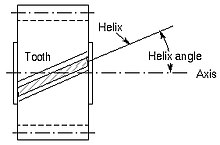
A straight-cut or spur gear, when cut at an angle, becomes a helical gear. A helical gear can support more torque in the same-size package because the length of the tooth is increased. The longer tooth and helix angle also increase the contact ratio.
While a spur gear will have 1.5 teeth in mesh at any time, a helical gear will have 3 teeth in mesh. The increased tooth mesh not only increases capacity but also minimizes local imperfections in the gear flank due to the larger contact area. This increased area allows for more error averaging, which makes the gear more accurate and enables it to run smoother with less noise.
Similar to pressure angle deviations, helix angle deviation will have both positive and negative effects on backlash.
But backlash tells only one part of the story. The variables that contribute to backlash also relate to other measures of accuracy. There is also transmission error.
Transmission error is the difference in expected position versus the true position. Transmission error is influenced heavily by runout, followed by the pressure and helix angle deviation. So, in some sense, transmission error is a better representation of gear quality.
Another specification related to accuracy is efficiency. The efficiency of the geartrain is influenced by runout and pitch deviation (or error) but is more affected by the tooth profile – pressure angle and helix angle deviation. Improvements in these, coupled with control of the microgeometry of the tooth flank can also yield higher torque capability.
So, when accuracy is being evaluated we need to be aware that other factors – directly related to quality and beyond backlash – need to be considered to make a more complete assessment on accuracy.